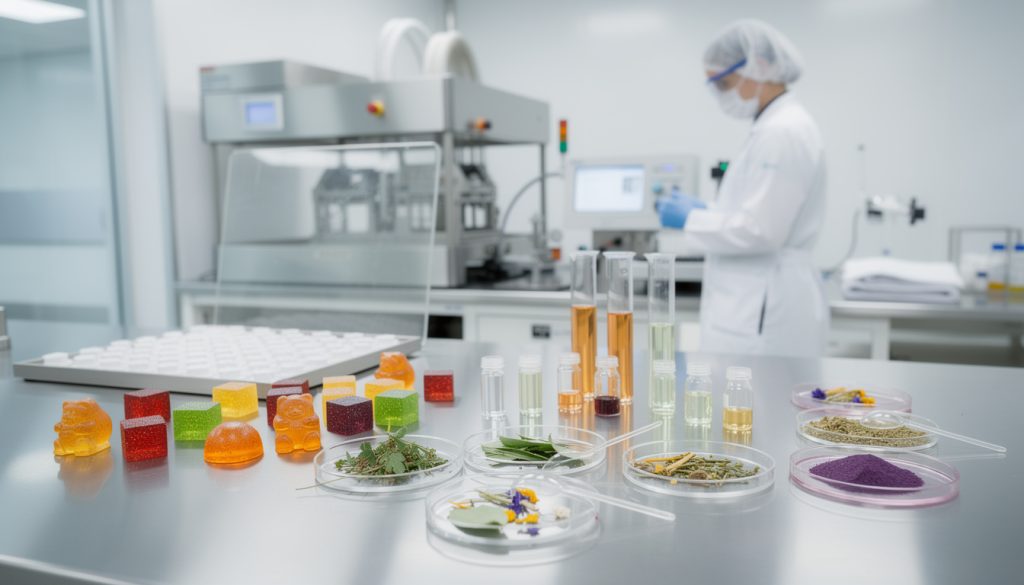
Custom Formulation Options for Private Label Gummy Supplements cover every adjustable layer of a product: the active ingredient matrix, the gelling base, the sensory profile, and the way nutrients are delivered per serving. Development runs from selecting nutritional actives, through base and flavor design, to stability validation and commercial scale-up. At each step, physical and chemical stability limit what is possible. Commercial feasibility, organoleptic balance, and regulatory compliance decide whether a concept becomes a shelf-ready product.
What Can Actually Be Customized in a Gummy Dosage Form?
Custom gummy supplement formulation allows changes to the active ingredient matrix, the gelling agent, colors (natural or artificial), flavor architecture, acid profile, and piece shape through mold selection. Private label gummy supplements built on stock formulas keep these parameters fixed. The stock route offers pre-validated performance and faster launch. A bespoke route, with proprietary blends or unusual sensory targets, needs its own validation cycle.
The gummy dosage form also has hard physical limits. A typical piece weighs 2.5 g to 4.0 g, and that mass caps the total payload. Extreme ingredient density breaks the gel network, causing incomplete setting, liquefaction, or early degradation of the actives.
Pectin Versus Gelatin: Choosing the Gelling Backbone
Gelatin gummies are known for elasticity and a pronounced chew. Structure depends on bloom strength, usually 200-250 bloom, and the gel softens at about 35°C, which makes warm-climate shipping a concern. Pectin gummies come from plant sources and give a cleaner bite and better heat tolerance. They also suit vegan gummies. The gelling behavior of plant-derived pectin depends on sugar solids and acidity, so the whole recipe has to be built around it.
Hybrid systems blend pectin with agar or tapioca starch to adjust chew and moisture retention. Sugar-free gummies replace sugar with maltitol, allulose, erythritol, or isomalt. Each option changes hygroscopicity, crystallization risk, and digestive tolerance, so the sweetener choice affects both texture and consumer comfort.
Common Mistakes in Active Ingredient Load and Dosing
The most frequent error is treating a gummy like a capsule. Active ingredient load generally stays within 10-15% of piece mass before the gel network weakens. A 1000 mg regimen therefore gets split across two to four gummies per serving, because one piece cannot hold it.
Chemistry causes the second round of failures. Acidic matrices at pH 3.2-3.6 can degrade certain vitamins, probiotics, and alkaline mineral salts. Hygroscopic botanical extracts and minerals such as magnesium or calcium pull water from the base, producing weeping, surface sweating, or grittiness. The sweetener system compounds the problem, since polyols and syrups also compete for available moisture.
Why a Bitter Botanical Fails the Taste Test
A gummy with an earthy or metallic active can look perfect on paper and still be rejected at first tasting. Flavor masking starts with the acidulant system. Citric, malic, tartaric, and lactic acids help set pectin, balance sweetness, and brighten flavor. Masking tools include microencapsulation of botanicals and bitter-blockers. Pairings help as well: berry or citrus against tart notes, coffee or chocolate against earthy ones.
Organoleptic testing then scores aroma, initial bite, chew resilience, flavor release curve, and lingering aftertaste across several iterations. Sugar, glucose syrup, stevia, and monk fruit each interact differently with actives, shifting mouthfeel and bulk density.
Stability Metrics That Decide Shelf Life
Stability testing quantifies potency over shelf life and shows how much overage each active needs. Protocols follow the logic of ICH Q1A(R2), pairing accelerated conditions (40°C / 75% RH) with real-time storage. A shelf-life study built this way sets realistic expiry dates and storage statements.
Moisture control is the main physical metric. Water activity (aw) between 0.55 and 0.65 limits microbial growth while avoiding hardening or syneresis. Documentation from GMP manufacturing normally includes a finished-product COA (Certificate of Analysis), raw material identity checks, heavy metals results, and microbial testing for pathogens. Packaging adds the last barrier: HDPE bottles with induction seals, multi-layer foil pouches, and desiccants for moisture- or oxygen-sensitive formulas.
From Bench Sample to Commercial Run
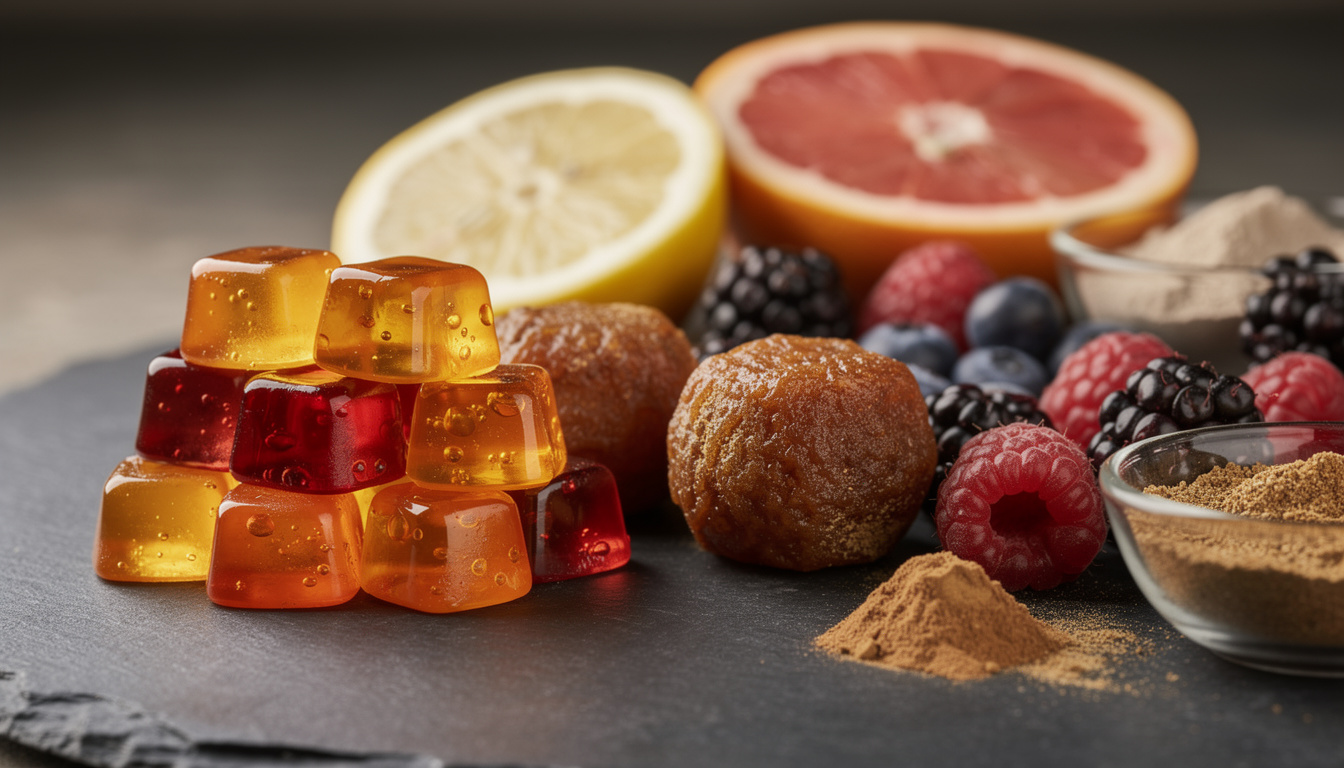
The development path moves from a discovery brief to laboratory samples, sensory sign-off, a pilot batch, and finally the commercial run. Minimum order quantities follow from minimum cooker batch capacity, mogul line deposition limits, and the cost of bespoke mold tooling.
| Phase | Typical duration | Main output |
|---|---|---|
| Raw material sourcing | 3-6 weeks | Verified actives and excipients |
| Formulation and prototype benchwork | 2-4 weeks | Sensory-approved samples |
| Analytical and micro clearance | 1-2 weeks | Release data |
| Commercial manufacturing | 4-8 weeks | Finished, packaged batch |
Pilot prototypes are judged on hardness, surface tackiness, color stability, and dissolution profile before commercial sign-off.
Can one gummy deliver a high-dose active?
Rarely. Because of the 2.5 g to 4.0 g piece weight and the limit on active load, high-dose regimens are usually spread across several gummies per serving.
Which base suits vegan products?
Pectin is the standard choice, since gelatin is animal-derived. Agar or starch blends can modify texture within a plant-based formula.
Why do some gummies sweat or turn gritty?
Hygroscopic minerals, botanical extracts, or polyol sweeteners move moisture around inside the piece, and weak packaging barriers add to the problem. Controlled water activity and proper packaging reduce both effects.
What documents accompany a finished batch?
A COA is standard, supported by identity verification of raw materials, heavy metals results, and microbial testing records from GMP manufacturing.
About the Business
Maya Plus is a leading manufacturer of high-quality food supplement and vitamin gummies. It offers private label solutions tailored to health-conscious consumers, retailers, and businesses. Its team develops innovative gummy formulations for men, women, kids, sports nutrition, and beauty applications, and is committed to delivering validated, compliant, premium custom gummy supplements for private label brands.